Đang tải thông tin quảng bá...
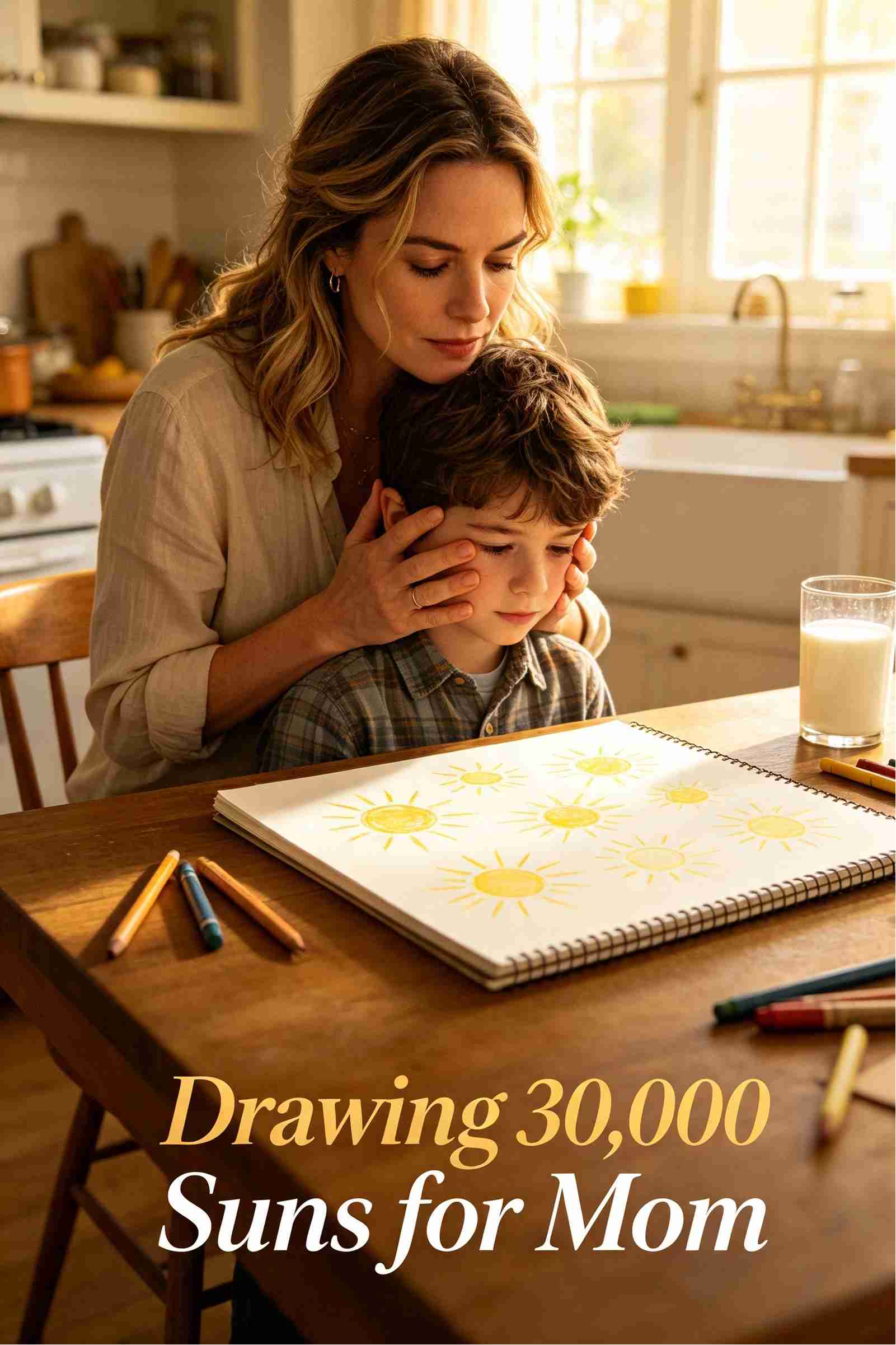
Drawing 30,000 Suns for Mom
 GoodNovel
Hoàn thành
GoodNovel
Hoàn thành
She cupped my face in her hands and said, slow and deliberate, "We're going to make a promise. Starting tomorrow, you'll draw one sun a day in your notebook. No skipping, no cheating—you have to fil...
Chương (1)
第1章
She cupped my face in her hands and said, slow and deliberate, "We're going to make a promise. Starting tomorrow, you'll draw one sun a day in your notebook. No skipping, no cheating—you have to fill it with thirty thousand suns. Only when you've drawn the last one can you come find me."
Chapter 1
My mother's palm cracked across my back—not hard, but loud.
"Jamie, tell me again. What's the first thing you do when you wake up in the morning?"
I kept my head down. "Get... get dressed."
"And then?"
"Brush my teeth... wash my face."
"And then?" Her voice was frantic.
My head felt stuffed with cotton. I looked at the piece of paper she'd left on the table—a little stick figure drawn next to a round yellow disc. A fried egg.
"Make... make a fried egg," I said.
"How?" She grabbed my shoulders and shook them. "What's the first step?"
"Turn... turn on the stove."
I remembered that one. There was a red flame drawn on the paper.
"Second step!"
"Pour... in the oil."
There was a clear little bottle drawn there too.
"Third step! Jamie! What's the third step?"
I couldn't remember. There was a cracked eggshell drawn on the paper, half broken open, and I didn't understand what it meant.
I looked at my mother. Her eyes were red.
"Mom... Jamie's... dumb."
She turned away from me all at once, her shoulders shaking. I heard her drag in a breath, and then a violent fit of coughing tore out of her throat. She clamped a hand over her mouth, but red liquid still leaked out between her fingers.
She turned back and pulled me into a hug, holding me so tight it hurt.
"Jamie... Mom doesn't have much time left. Mom's going to another world soon. You have to learn to... take care of yourself."
I didn't understand what another world was. I only knew my mother was shaking, and her tears burned where they fell on my neck.
"Wherever Mom goes, Jamie goes too."
I cried and kissed her neck, and told her, very seriously, "Jamie's going with Mom."
"No!" She pushed me back, her red-rimmed eyes fixed on mine. "Jamie, don't cry! Be strong!"
I was so startled I swallowed my tears.
She cupped my face in her hands and said, slow and deliberate, "We're going to make a promise. Starting tomorrow, you'll draw one sun a day in your notebook. No skipping, no cheating—you have to fill it with thirty thousand suns. Only when you've drawn the last one can you come find me."
Thirty thousand suns...?
"This isn't a request. It's an order. A promise." She wiped the tear tracks off my face. "Remember—until you finish, Mom won't see you. And if you sneak off to find me before you're done, you'll never see Mom again."
I didn't fully understand, but I understood that last part.
"Okay! Jamie... won't cry. Jamie will draw suns."
...
My mother slept a long sleep. It had been three days.
She hadn't coughed once. She hadn't made me recite the steps for frying an egg. She slept so quietly, her face pale as the clouds outside, and that red water that used to come out of her mouth like shattered flower petals didn't come anymore.
I sat on the little stool by her bed and held her hand. It was cold, cold as the frost that crept over our window in winter. I tucked it into my armpit, trying to warm it the way she used to warm my feet. It didn't work. Her hand stayed cold.
That day, a lot of men came to the house, all wearing the same blue uniforms.
Carol Dawson, our downstairs neighbor, came too. Her eyes went red the second she walked in. She crouched down and touched my head, her mouth working like she wanted to say something, but nothing came out—just a long, heavy sigh.
The men went into my mother's room and carried her out on the bed. They'd covered her with a white sheet, cleaner than any sheet we'd ever owned—no yellow stain on it from the nights I wet the bed.
I wanted to follow. I wanted to see where they were taking her. She was going to another world. She'd told me herself.
Mrs. Dawson grabbed my arm. "Be a good boy, Jamie. You can't watch this."
I didn't understand why not. My mother going to another world was important. And then I remembered our promise. She'd said I couldn't follow her—that I had to start drawing suns, or I'd be breaking the rules. A child who broke the rules would never see his mother again.
I wrenched free of Mrs. Dawson and ran back to my room. I dragged out the battered cardboard box from under my bed. Inside was the new notebook my mother had filled with hundreds of little squares, and a full box of yellow crayons. I lay flat on the floor, picked out the yellowest crayon, and pressed hard, drawing my first sun in the first square.
It wasn't round. It came out crooked, like a fried egg someone had sat on.
I drew a second one. Then a third. Each time, I counted in my head. One, two, three. Still such a long way to thirty thousand.
I was still drawing, hard at work, when Mrs. Dawson pushed open my door. Behind her stood a tall, thin woman.
Mrs. Dawson pointed at her. "Jamie, this is your sister."
I looked up. She was pretty, with long hair and big eyes. But there was no light in those eyes—they were like the black glass marble I'd lost under my bed, cold enough to make my skin crawl.
Her jeans were ripped through in several places, and a cigarette hung from her lips. The smoke stung my nose.
I remembered my mother telling me I had a sister. In the photos, that sister had been smiling. This woman standing in front of me wasn't smiling at all.
I got up off the floor and walked over to her, leaning in the way a puppy would, sniffing carefully. My mother's smell was soap and sun-warmed blankets, all mixed together—warm enough to make you want to fall asleep just breathing it in. This sister smelled like something cold: rain and metal, sharp and unpleasant. She wasn't my family. Family didn't smell like that.
She saw me sniffing at her and frowned, hard, stepping back like I was some filthy stray dog.
"Fine. I get it. I'll take him," she told Mrs. Dawson. Her voice was dry and flat.
Mrs. Dawson looked like she wanted to say more, but in the end, she just touched my head, tucked my crayons and notebook into my backpack, and let it go.
And that's how I left with the sister who didn't smell like sunshine.
Chapter 2
Vivian Reed drove fast. Outside the window, the houses and trees blurred into gray smears.
Her building was tall—so tall we had to ride up in a big metal box that dinged when it stopped. The apartment itself was small and cluttered, messier even than the home I'd shared with my mother, and the air inside smelled bad.
She pointed to a small, pitch-dark room stacked with cardboard boxes. "You sleep here from now on." Then she pointed at a corner. "That's the bathroom. Drink water if you're hungry. Don't come out. Don't make noise."
She shut her own bedroom door behind her.
This home was colder than the inside of her car had been.
I spread the little blanket my mother had left me on the floor, hugged my backpack, and sat down on top of it. I didn't dare move. I didn't dare make a sound.
At night, Vivian would set a bag of stale crackers on the floor outside my door, knock once, and walk away. They were salty and not very good, but eating them kept my stomach from growling. I was hungry enough that at night I'd crush them into crumbs and lick them up bit by bit off my palm, just to make the bag last longer.
One day, while I sat in the storage room drawing my sun, I heard someone knock at the front door. It was Margaret Ellis from next door—Granny Ellis, as everyone in the building called her. She was holding a steaming bowl of pierogies. When she saw me, she froze for a second, sighed, and called Vivian out of her room.
"Vivvy, how could you let this child eat that?" Granny Ellis pointed at the bag of crackers by my feet, her voice sharp. "Look how thin he is. A stiff wind could blow him away."
Vivian leaned against the doorframe and gave a cold laugh. "He's an idiot. He should be grateful for whatever he gets. What, Granny Ellis, does it break your heart? Take him home and feed him yourself, then."
"How can you talk about the boy that way!" Granny Ellis's face went red with anger. She pressed the bowl of pierogies into my hands, pulled me out into the hallway, and whispered to Vivian. "Don't talk about him like that. He's just slow. But look how well-behaved he is—all these days here, and he hasn't cried or made a fuss once. I heard his mother cut ties with her entire family for your father's sake and raised him alone. Hard life. And then to get lung cancer so young, without ever once giving up on this boy—"
"So what!" Vivian's voice suddenly rose, sharp as a cat with its tail stepped on. It made me jump too. "What about my father? He gambled his way into learning card tricks to pay for this idiot's treatment, and got beaten to death for it! When he left me and my mother for this idiot's mother, did he ever once think about us? My mother hated him for it her whole life—hated me too, because of him—until she finally ran off with some drifter. Why does his precious little family of three get to love each other so much, while I'm the one stuck cleaning up this mess?"
She threw one last hard look at me and Granny Ellis, then slammed the door.
Granny Ellis let out another sigh beside me.
I held the warm bowl of pierogies. They smelled wonderful. But I couldn't eat.
I didn't understand most of what Vivian had said—something about card tricks, something about a drifter. I only understood two things. One was "idiot." Granny Ellis said I was slow; Vivian called me an idiot. The other was that my father was gone. He'd gone to the other world before my mother even had.
I looked down at the plump white pierogies in the bowl.
A tear fell and landed right in it.
Chapter 3
Vivian got a boyfriend.
I didn't like him.
Whenever he came over, the rain smell on Vivian faded, replaced by something more frightening—like rusted metal, sharp as a blade. He had a long, twisted worm tattooed down his arm, and when he laughed, his mouth stretched wide and showed off yellow teeth.
The first time he saw me, he pinched my cheek and told Vivian, "This is the little bastard? He really does look stupid."
He'd snatch the crackers Vivian gave me right out of my hands and crunch through them in front of my face while my stomach growled, laughing at me the whole time.
Once, he burned the back of my hand with a thin stick that glowed red at the tip. It hurt like a wasp sting. I yanked my hand back, tears welling up. My mother had told me not to cry, so I forced myself to hold it in, staring at the small black mark on my skin. Seeing that I hadn't cried only seemed to make him angrier.
"Look at this idiot, acting tough." He grabbed my notebook full of crooked yellow suns and laughed even louder, waving it at me. "What's the point of drawing this crap? Can you eat it? An idiot's an idiot."
He threw the notebook on the floor and ground his heel into it.
Vivian just sat on the couch nearby, watching, cold and silent. She didn't say a word—as if it wasn't my hand that had been burned, wasn't my suns being crushed underfoot, just some table, some chair.
After that, whenever the man who smelled like rusted blades showed up, I'd rush to hide in the farthest corner of the storage room, burying my face in the little blanket my mother had left me, breathing in what was left of her scent, hoping he couldn't smell me out, couldn't find me. I was afraid of him the way I was afraid of the big yellow dog on the corner that bit people.
My most treasured possession was the music box my mother had left me—a wooden box painted with a single star. Turn the little handle on the side, and it played "Twinkle, Twinkle, Little Star." My mother had told me she was a star in the sky now, and that if I ever missed her, all I had to do was listen.
Every night, after I finished drawing my sun, I'd hide under the blanket with my head tucked all the way in and listen in secret. The music was so quiet, it felt like a secret just between me and her.
One night, I listened until I fell asleep. In the middle of the night, my door slammed open. Vivian burst in, her eyes red, glaring at me like a rabbit gone half-mad.
"Who told you you could play that? Who told you?"
She snatched the music box out of my arms. I was too scared to speak, and I reached out to grab it back. She looked furious—more furious than I'd ever seen her—and she flung her arm out. The wooden box sailed across the room and shattered against the wall into a hundred splintered pieces.
The music stopped, all at once.
The whole world went quiet.
Vivian froze too. She stared down at the broken pieces on the floor, and for a second, she looked more devastated than I felt. She sank down slowly and covered her face with her hands.
I didn't cry. My mother had told me not to.
I climbed off the bed and picked up every last piece, one by one, and put them in my pocket. That way, they wouldn't be cold anymore. They wouldn't be alone.
Chapter 4
Vivian and the man who smelled like rusted blades were fighting.
I was in the storage room, listening to things crash outside—plates, bowls, cups, shattering one after another like firecrackers on New Year's. I could hear Vivian crying too. Her crying didn't sound like mine, all locked up in my throat. Hers was sharp, like a knife scraping glass, and it made the hair on my arms stand up.
After a long, long time, it finally went quiet outside.
I eased the door open a crack. Vivian sat alone on the floor, surrounded by broken porcelain. A long gash ran across the back of her hand, bleeding steadily—drops of red hitting the floor, one after another, like the little flower-petal clots my mother used to cough up. The rain smell coming off her had turned thick and heavy.
I thought of my mother. She'd told me that if you were bleeding, you had to hurry and put on one of the magic bandages that blew the pain away. I ran back to my corner and dug through the little tin box my mother had left me until I found a magic bandage—my last one. It had a cute little bear printed on it.
I peeled the backing off, the way I'd seen my mother do, and crept over to Vivian. I crouched down, wanting to press the bear onto her cut. The second my hand touched her, she flinched like she'd been shocked.
"Get away from me!"
She knocked my hand aside like it had burned her. The bandage went flying and landed in the middle of the broken porcelain, the cute little bear's face smeared with dirt. That stung a little. It was my last one. Once it was ruined, there wouldn't be another.
Vivian didn't move again after she snapped at me. She stared at the dirty bear-shaped bandage on the floor, frozen. Her eyes weren't like ice anymore, and they weren't like blades either. There was something in them I couldn't understand—something like a fog that wouldn't clear.
That was when the door banged open again.
It was him. He'd come back, reeking of alcohol worse than he ever smelled of blades. He saw the blood on Vivian's hand, then saw me on the floor, and he smiled.
"What, you think this idiot's going to save you?"
Vivian ignored him. She got slowly to her feet and stepped in front of me.
His smile vanished. He crossed the room, grabbed a fistful of her hair, and slammed her against the wall.
"You're still protecting him? He's a bastard! A dead weight! Vivian, I'm telling you, this idiot is nothing but bad luck. He'll drag you down with him sooner or later."
Vivian said nothing, just bit down on her lip.
That seemed to make him angrier. He let go of her and scanned the room, his eyes finally landing on the knife rack in the kitchen. They lit up—hungry, the way a starved wolf's would. He walked toward the kitchen, muttering under his breath.
"I've been telling you—trouble like this, you deal with it once and for all." He licked his cracked lips and picked up the longest, sharpest knife on the rack. "I've got a way to shut both of you up. Permanently."